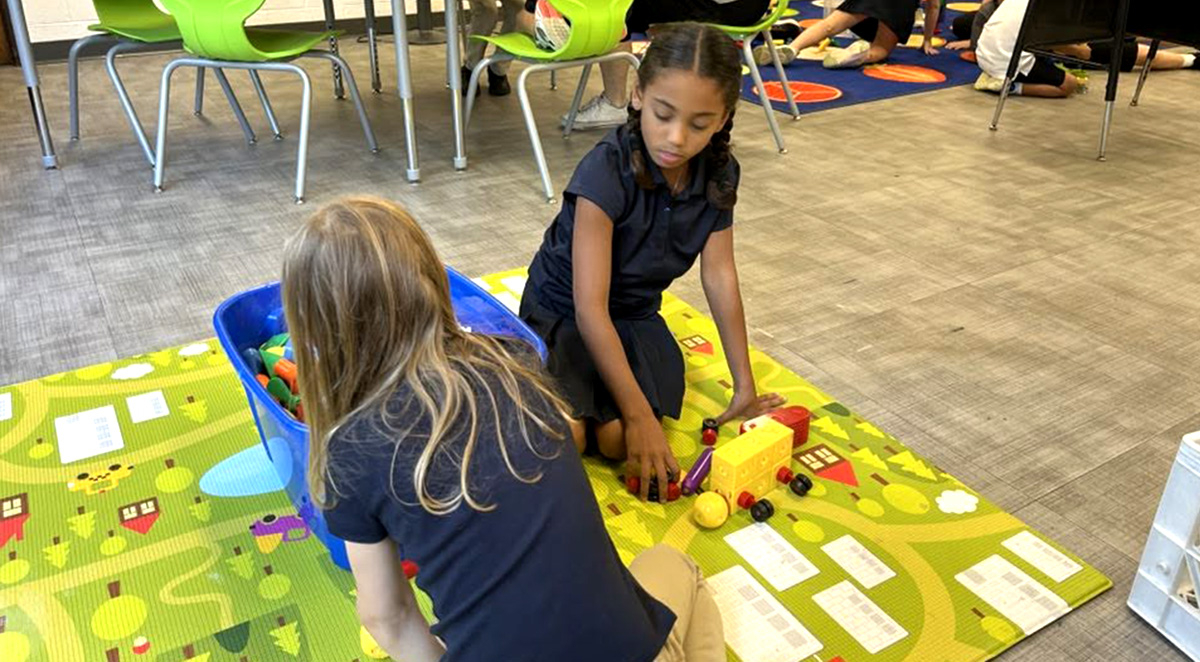
Ask parents what they hope their child gains from a school year and the answers come quickly: strong reading skills, confidence in math, a growing faith, good friends. Play rarely makes the list. Yet play is one of the primary ways children build every one of those things, and it deserves a place in the conversation as a new school year approaches.
At St. Paul Lutheran School in Northville, one conviction shapes our daily schedule: children learn best when their bodies, minds, and spirits are all engaged. Our mission calls us to help each child grow spiritually, emotionally, intellectually, socially, and physically to the best of his or her God-given ability. That fifth word matters as much as the others, and play is where much of that growth happens.
Quick Summary
- Play is not a break from learning. It is one of the ways children process, practice, and retain what they learn.
- Federal guidance recommends 60 minutes or more of daily physical activity for children ages 6 to 17, and school-based activity helps children reach that goal.
- Recess benefits include sharper focus, stronger peer relationships, better mood, and growing self-regulation.
- A Christian view of play treats it as an expression of joy, rest, and wonder that reflects God's design for childhood.
- St. Paul builds movement and creativity into the day through daily recess, required physical education, and hands-on classroom learning.
Why Play Is Not the Opposite of Learning
Somewhere along the way, play and academics became framed as competitors. If a school wants higher test scores, the logic goes, it should trade playtime for instructional minutes. That framing misunderstands how children develop.
Play Is How Children Rehearse Real Skills
Watch children on a playground and you will see cognitive work happening in real time. A group inventing a game must agree on rules, which requires negotiation and verbal reasoning. Two friends settling whose turn it is are practicing perspective-taking, the same skill they will need to interpret a character's motives in a novel three years later.
This is why play in education remains such a durable topic in child development research. Play gives children repetitions in problem solving, language, and social reasoning, and the stakes feel low to the child, which is precisely what allows the practice to happen freely.
Movement Supports the Brain That Does the Learning
Physical activity is not separate from academic readiness. The Centers for Disease Control and Prevention advises that children ages 3 to 5 be physically active throughout the day, and that children and adolescents ages 6 to 17 get 60 minutes or more of moderate-to-vigorous activity daily, including aerobic, muscle-strengthening, and bone-strengthening activity. The same guidance notes that school-based physical activity helps children reach that daily total. A child who spends seven hours seated is unlikely to make up the difference between dismissal and dinner.
A Christian Understanding of Play
For Christian families there is a deeper layer here. Play is not simply useful. It is good, and it reflects something true about the God who made children.
Scripture describes a God who established rhythms of work and rest, who filled creation with beauty that serves no purpose beyond delight, and who welcomed children directly rather than treating them as small adults in waiting. Zechariah 8:5 pictures a restored city with streets full of children playing, offered as an image of blessing and peace.
This shapes how we talk to children about their own time. A child taught that only measurable output counts learns to view rest as laziness. A child taught that God delights in joy, creativity, and friendship learns to receive rest as a gift. That distinction shapes how a person handles pressure at 15, at 25, and at 45.
Recess Benefits That Show Up in the Classroom
Recess is the most visible form of play in a school day, and it earns its place. At St. Paul, students eat lunch from 11:50 a.m. to 12:20 p.m., followed by recess from 12:25 p.m. to 12:55 p.m. That half hour does considerable work:
- Attention reset. Focus depletes over a morning, and a break involving movement restores capacity better than switching subjects.
- Peer skill development. Recess is child-directed, so students practice conflict resolution, inclusion, and leadership without an adult scripting the interaction.
- Emotional regulation. Physical activity is one of the most reliable tools children have for managing frustration and restlessness.
- Physical health. Running, climbing, and chasing games build the bone, muscle, and cardiovascular fitness that activity guidance emphasizes.
- Creativity. Unstructured time is where children pursue interests no curriculum assigned to them.
Practical details support all of it. Our dress code requires athletic shoes for recess, students keep a separate pair of gym shoes at school for gym class and indoor recess, and boots are expected in muddy or snowy Michigan weather. Small policies, clear purpose: children should be ready to actually move. Read our blog about how Christian schools help build emotionally intelligent kids.
How Play Supports Whole Child Development at St. Paul
Whole child development appears in many school mission statements. What matters is whether the daily schedule reflects it. Here is where movement and play live in our daily schedule:
Physical Education for Every Grade Level
All students participate in regular physical education unless a parent provides a valid excuse in writing or by telephone. In the earliest grades, students learn basic large motor skills through practice and games, with sportsmanship emphasized through fitness challenges, chasing and fleeing games, obstacle courses, and target games. By the middle grades, students apply grade-appropriate object control skills and work toward cooperating with others within an activity strategy, with team sports and team challenges added. The physical skills grow, and so do the social ones.
Small Classes Make Play More Inclusive
Class size affects playtime more than parents expect. Kindergarten is capped at sixteen students and grades 1 through 8 at twenty, and our multi-graded classrooms mean teachers know each child as an individual and, in most cases, work with each child over two years.
On a playground that familiarity is a real advantage. Teachers who know every student can spot the child on the edge of the group, redirect a game turning unkind, and connect students with shared interests.
Hands-On Learning Beyond the Playground
Play-informed learning continues inside the K-8 program. Science instruction moves through demonstrations, group activities, and hands-on labs, culminating in the annual St. Paul Science Fair where students present their work to family, friends, and the community. Art classes ask students to make creative decisions and solve creative problems. Field trips have included an apple orchard, plays at the Marquis Theatre, Cranbrook Science, and a visit from the Northville Fire Fighters.
Play, Character, and School Wellness
School wellness is often reduced to nutrition posters and a spring fitness week. A fuller definition includes whether children feel known, whether they have space to be joyful, and whether they are learning to treat one another well.
The playground is one of the most honest character-formation settings a school has. Do I include the child nobody picked? Do I admit I was out when the call went my way? Do I win graciously, or lose without blaming someone?
Because Christ is at the center of instruction at St. Paul, teachers can name those moments directly. A dispute over a game becomes a chance to talk about forgiveness, and a child who welcomes a newcomer becomes a living example of loving your neighbor. Faith formation and recess are not in separate compartments.
Protecting Play at Home
Parents shape a child's relationship with play more than any school does. A few commitments go a long way:
- Leave unscheduled time on the calendar, since boredom is often the doorway to imagination.
- Get outside daily, even briefly, and even in a Michigan winter.
- Choose open-ended materials over single-purpose toys. Blocks and art supplies stretch further than devices.
- Play with your child sometimes, then step back. Both matter.
- Talk about rest as a gift from God rather than a reward for productivity.
If you are considering a Christian School, read more about the essential qualities parents should look for in a Christ-based education.
Frequently Asked Questions
Does play-based learning mean less academic rigor?
No. Students at St. Paul receive instruction in all subject areas required by the State of Michigan, taught from a Lutheran Christian perspective, and they regularly score well above the national average on standardized tests. Play and movement support that academic work rather than replacing it.
How much recess do students at St. Paul get?
Students have a scheduled recess period from 12:25 p.m. to 12:55 p.m. following lunch, and all students also participate in regular physical education classes as part of the curriculum.
What happens on bad weather days?
Indoor recess takes place when conditions require it, which is why students keep a separate pair of gym shoes at school. Boots are expected in muddy or snowy weather, with shoes brought along for the classroom.
Is play still important for middle school students?
Yes, though the form changes. For grades 6 through 8, physical education shifts toward fitness challenges, team sports, and team challenges, and extracurricular activities such as Bible Quizzing give older students structured social outlets. Adolescents need movement and friendship just as younger children do.
Bringing Faith, Learning, and Joy Together
St. Paul Lutheran School has served Northville families since 1896, and our approach rests on a simple conviction: each student is a Child of God gifted with the potential to achieve success. Serving that potential means teaching reading and math with real rigor. It also means guarding the half hour after lunch, building movement into every grade level, and treating a child's joy as something worth protecting.
If you want to see how a Christ-centered program balances academic excellence with genuine childhood, we would be glad to show you. Visit our admissions page to request information or schedule a campus visit, where you can meet our teachers and see our students at work and at play.